
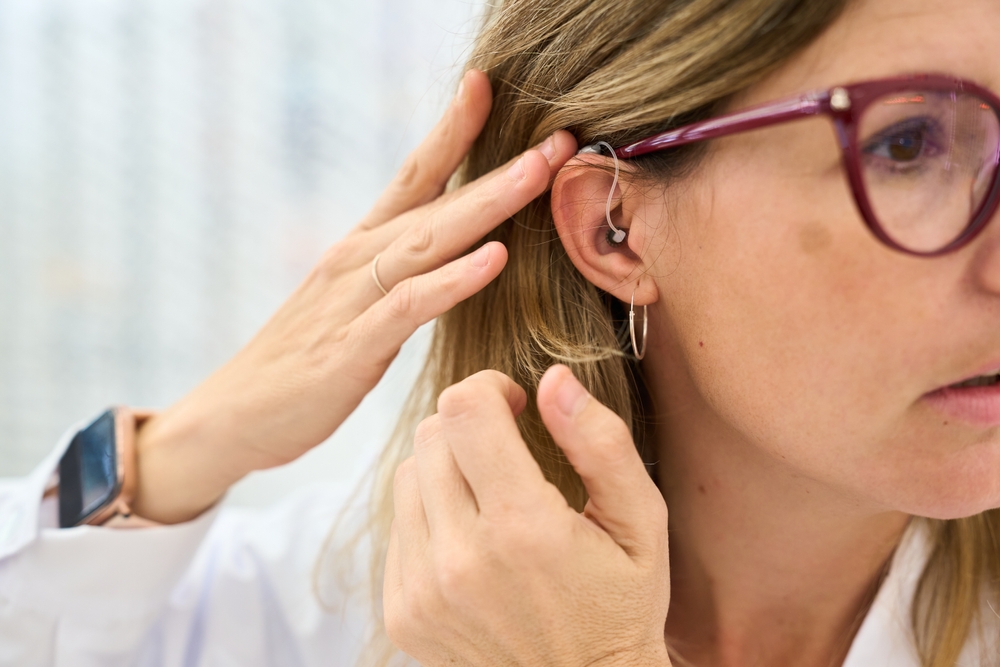
A primary reason individuals put off addressing auditory deficits is the assumption that assistive devices will be unsightly or awkward to wear. Historically, old-fashioned hearing hardware was bulky, obvious to onlookers, and closely linked with the stigmas of aging. In some cases, people even worried that they might be left out of conversation altogether by others who assumed they wouldn’t be able to hear or comprehend.
This obsolete perception remains deeply embedded in the public consciousness, creating a massive barrier to proactive treatment. The liberating truth is that twenty-first-century auditory tech offers a level of cosmetic elegance and physical comfort that surprises most patients. Advances in design and technology have made them smaller, more comfortable, and far more discreet.
Should your reluctance stem entirely from memories of obsolete, bulky hardware, you owe it to yourself to discover current medical advancements.
The Outdated Devices of Your Imagination Have Been Replaced
When asked to visualize a hearing instrument, the average person still envisions an awkward, highly conspicuous piece of hardware visible from yards away. If that description matches your mental model, your perceptions are anchored in the primitive analog technology of the late twentieth century.
Since then, the entire category has evolved. Exponential leaps in digital circuit shrinking, industrial design, and audio computing have totally redefined contemporary hardware. They’re smaller, sleeker, and designed to blend in (or disappear entirely).
Numerous modern instruments are inserted completely within the ear canal structure, rendering them undetectable throughout standard daily dialogue. Different configurations sit comfortably behind the ear but feature such a low profile and featherweight build that observers naturally miss them.
Navigating Modern Hearing Technology: The Three Core Styles Evaluated
If you are curious about the structural choices available for your rehabilitation, here is an accessible overview of current styles:
Deep Canal Solutions: Invisible-in-Canal (IIC)
These are as discreet as it gets. An IIC device is positioned entirely past the second bend of the auditory canal, fabricated from a personalized physical matrix of your unique anatomy. During typical face-to-face communication, these custom models remain completely obscured from view. This configuration is highly favored by individuals managing mild-to-moderate auditory drops who demand total aesthetic secrecy.
Modern Standards: Receiver-in-Canal (RIC) / Receiver-in-the-Ear (RITE)
This particular layout has become the benchmark standard for contemporary hearing health restoration. A micro-housing rests behind the upper pinna, transferring processed sound via an ultra-fine, translucent micro-wire to an acoustic driver nestled inside the canal. To onlookers, this streamlined design closely mirrors fashionable consumer electronics or sports earbuds. The vast majority of peers will fail to perceive the apparatus unless conducting a highly deliberate close-up inspection.
Power and Performance: Behind-the-Ear (BTE)
While these models house all electronic components within a casing resting behind the pinna, their dimensions are drastically reduced compared to legacy models. Frequently utilized to remediate severe-to-profound auditory loss, they maximize gain and processing capability while maintaining a highly professional, low-profile aesthetic.
Ultimately, contemporary hearing aids are built to empower your daily routine rather than broadcast a medical condition to the world.
How Current Hearing Technology Outperforms Traditional Amplifiers
The evolution of these medical devices encompasses much more than a superficial face-lift. Present-day models perform like advanced personal audio computers instead of basic medical listening aids. A vast majority feature native Bluetooth connectivity, enabling seamless, wireless streaming of telephonic communication, media, and television audio directly into your auditory pathway.
Through proprietary mobile apps, patients can effortlessly adjust acoustic thresholds or modify directional settings completely hands-free. For instance, when entering a highly reverberant dining space, you can suppress ambient acoustic noise and sharpen speech clarity in mere moments. Advanced rechargeable battery banks have effectively replaced the small, fragile power cells that used to cause immense frustration. You merely dock the devices on a nightstand inductive charger, exactly like replenishing your mobile phone.
Getting Over the Fear and Stigma of Hearing Devices
Despite being aware of these massive design improvements, it is entirely normal to feel a sense of hesitation. Exploring hearing aid options can be challenging on a mental and emotional level because it’s an admission that our hearing isn’t what it used to be. This mental hurdle can make an individual feel exposed, creating a false impression of losing authority over personal wellness.
Let’s reframe this narrative completely: acquiring a modern acoustic instrument is not an admission of weakness. They’re simply a sign of change, which happens to us all. They’re proof that you’re taking action to support and equip your body in essential ways.
Consider the profound joy of wearing a tiny, unnoticeable device that lets you confidently command group discussions, master noisy environments, and immerse yourself in what matters most. Talk about empowering!
Schedule Your Personal Demonstration of Today’s Top Styles
To dismantle old assumptions, the best strategy is to witness these design breakthroughs with your own eyes. We encourage you to drop by our office, address your concerns, and hold these miniature devices yourself with zero sales pressure. Think of your visit as an educational open-house to experience the lightweight engineering of modern hearing instruments firsthand.
You will likely be utterly delighted to discover how microscopic, physically seamless, and high-performing today’s options truly are! Do not let outdated myths delay your wellness—call our specialized practice or book your appointment online today.